
Repairing a single component is usually faster and cheaper. But if the fix doesn't restore the door's listed fire-resistance performance, you've spent money on something that still fails inspection and still puts occupants at risk. More than 65% of fire doors fail their annual inspection, and the good news is that over 90% of those failures can be corrected within a normal facility maintenance budget, based on Hogan Security Group's own 2025 field data.
This decision affects occupant safety, smoke and fire containment, inspection outcomes, liability, and how much downtime your facility absorbs. Repair works when the defect is limited and correctable with approved parts. Replacement becomes necessary when the door's core, identity, listing, or structural integrity is compromised. A qualified fire-door professional, and your local authority having jurisdiction (AHJ), should confirm the final call either way.
Key Takeaways
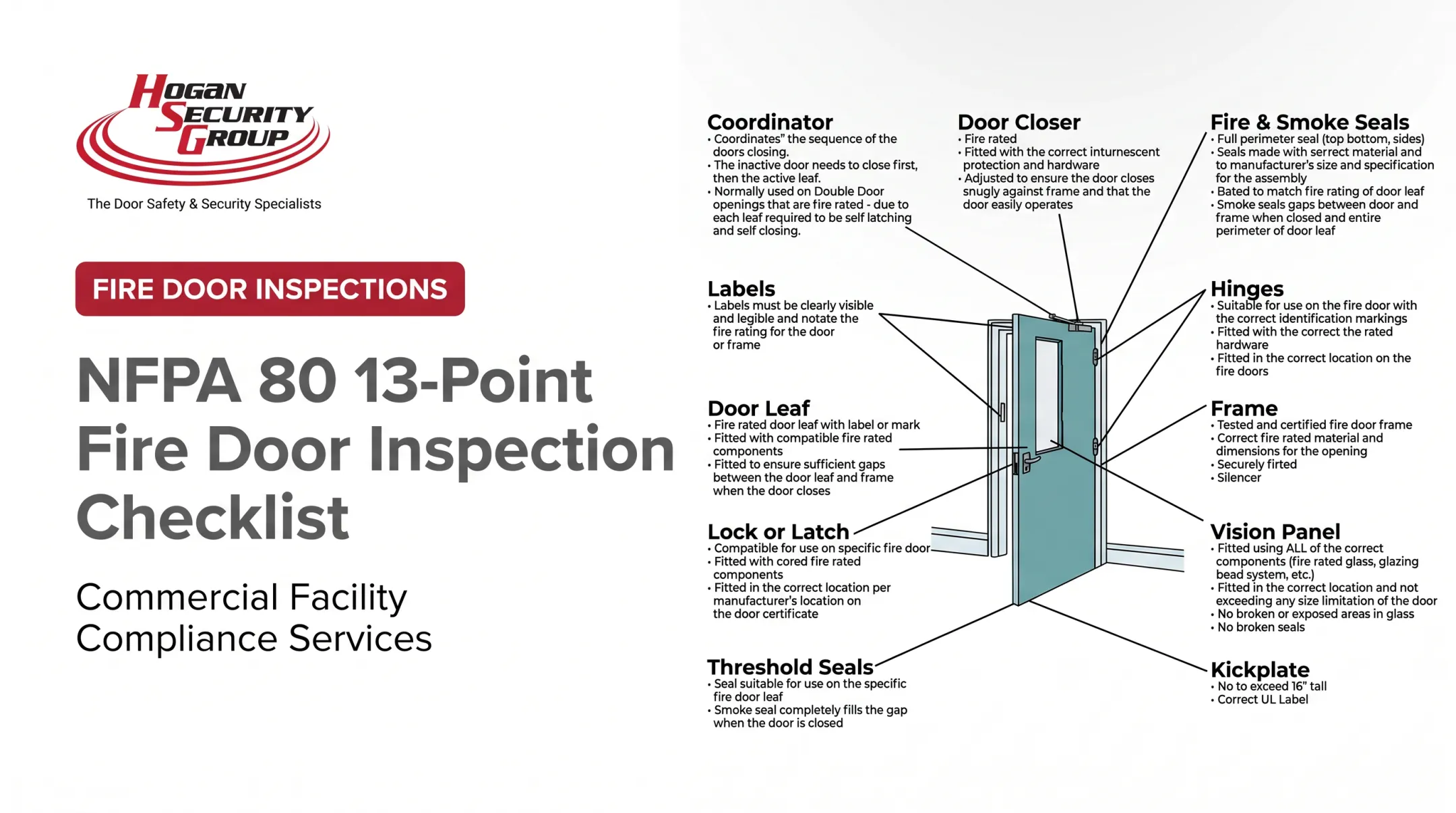
- Evaluate the whole assembly: leaf, frame, hinges, closer, latch, seals, glazing, and hardware together.
- Worn seals, loose hardware, and misadjusted closers are usually repairable with listed, compatible parts.
- Major structural damage, unapproved holes, or untraceable labels typically push the decision toward replacement.
- Generic caulk, non-rated hardware, and field-cut penetrations can void a listed assembly even if the repair looks fine.
- Keep written records of every defect, repair, replacement, and inspection for your fire-safety file.
Damaged Fire Doors: Repair or Replacement—Quick Comparison
Repair restores a specific defect while keeping the existing listed assembly, provided its performance can be verified afterward. Replacement removes and installs a new door, frame, or complete opening when the current unit can't reliably hold its rating.
| Factor | Repair | Replacement |
|---|---|---|
| What it addresses | A single defect in an otherwise sound, verifiable assembly | A door, frame, or opening that can't be trusted to meet its rating |
| Cost | Usually lower; limited to parts and labor for the specific issue | Usually higher; includes new hardware, installation, disposal, and sometimes frame or wall work |
| Downtime | Minimal, since the opening largely stays in place | More involved; may require temporary access control and occupant coordination |
| Typical examples | Compatible seals, closer adjustment, hinge replacement, latch alignment, minor frame fastening | Severe leaf damage, major warping, unapproved cutouts, an unrepairable frame, unverifiable rating |
Neither route is a shortcut around compliance. Both must preserve the required fire rating and follow the manufacturer's instructions, adopted building codes, and applicable NFPA guidance.
Cost figures vary too much by region and door type to quote a flat number here. An itemized assessment from a qualified contractor will always beat a generic online estimate.
Repair or Replace? How to Evaluate the Damage
Here's the part facility teams often miss: a fire door can look completely functional and still fail to provide its required protection. A component-level defect, like a worn seal, is different from damage that compromises the tested assembly itself.
Inspection criteria focus on closing, latching, clearances, and component condition, not just visual appearance, according to NFPA's 2025 guidance on fire door assemblies.
Repair is generally on the table when:
- The leaf and frame remain structurally sound
- The assembly's rating and identity can be verified from labels or records
- The door closes and latches correctly once adjusted
- Replacement parts are listed, labeled, or otherwise approved for that specific assembly
Replacement becomes the more likely path when you find:
- Holes or cutouts that were never approved by the manufacturer or listing lab
- Delamination or an exposed, damaged core
- Severe warping that prevents a tight, even close
- Heat or fire damage to the door materials
- An irreparably corroded or distorted frame
- Missing labels or documentation that make the rating impossible to confirm
Repair work isn't automatically compliant just because it closes the gap. NFPA80 allows abandoned fastener holes to be filled with matching material or steel fasteners, but anything outside that narrow provision counts as a field modification requiring review, according to Allegion's technical guidance on the standard.
Generic patching, the wrong seal profile, or field-drilled holes can invalidate a listed assembly.
If a fire door won't close and latch on its own, treat it as an urgent repair, not a maintenance ticket. Don't wedge it open or rely on a temporary workaround while you wait for parts.
When Should a Damaged Fire Door Be Repaired?
A damaged fire door can be repaired when the core assembly remains sound and listed components can restore its rating. A proper evaluation follows a sequence, not a glance. A qualified inspector typically works through these steps:
- Identify the door and its rating using existing labels or documentation
- Inspect the leaf and frame for structural soundness
- Test self-closing and latching function under normal operation
- Examine seals and hardware for wear, gaps, or missing pieces
- Check glazing and labels for legibility and compliance
- Compare proposed work against manufacturer requirements before any parts get ordered

When the core assembly checks out, repair protects the budget without compromising safety. Schools, hospitals, warehouses, and multi-tenant properties with dozens or hundreds of rated openings benefit most from catching failures at this stage.
Hogan Security Group's FDAI-certified inspectors routinely find that most inspection failures fall into this repairable category rather than requiring a full teardown.
Once the repair is done, verification isn't optional. A completed job should confirm:
- The door closes and latches fully every time
- Seals and gaskets are seated correctly for that specific assembly
- Hardware is secure and torqued to spec
- Clearances match the listed requirements
- The work is logged for the facility's fire-safety file
Compatible parts matter here too. Hogan works directly with manufacturers including Allegion, Assa Abloy, dormakaba, and Special-Lite, which keeps repairs tied to listed components rather than whatever's available on a parts truck.
When Is Fire Door Replacement the Safer Choice?
A fire door's age rarely decides its fate on its own. What matters is whether the assembly can still be identified, maintained, and restored to its required performance. A 30-year-old door with intact documentation and sound hardware can outlast a 5-year-old door that's been through three bad repairs.
Replacement becomes the more reliable option when you're dealing with:
- Repeated repairs that keep reopening the same underlying problem
- Hardware or parts no longer supported by the original manufacturer
- Missing or illegible labels with no documentation to fall back on
- Extensive corrosion or moisture damage to the leaf or frame
- Impact damage from forklifts, carts, or heavy equipment
- A frame that's shifted, rusted, or distorted beyond square
Persistent gap problems are a good example. Hinge shims and hardware swaps can correct an excessive gap, but door and frame replacement becomes the practical option once those fixes stop holding, according to NFPA Journal's 2019 report on the issue.

Replacement doesn't automatically mean gutting the whole opening. Depending on the inspection findings, it might involve only the leaf, only the frame, only the hardware, or the complete assembly. Selection should weigh:
- The required fire and smoke rating for that location
- Door size, weight, and daily traffic volume
- Egress function and accessibility requirements
- Glazing type and the size limits tied to its listing
- Hardware compatibility with the existing wall and frame
Installation should be handled by a qualified contractor using a listed assembly, followed by inspection and updated facility records. Skipping that last step just recreates the documentation problem you started with.
How to Decide Between Repair and Replacement
Five questions can cut through most of the uncertainty:
- Can the door's rating and identity be verified?
- Is the damage cosmetic, component-level, or structural?
- Does the door close and latch reliably after adjustment?
- Are approved replacement parts and repair methods actually available?
- Can the finished work be documented and accepted by the AHJ?
The decision shouldn't come down to the cheapest quote. Weigh the upfront repair expense against:
- Recurring service calls
- Repeated inspection failures
- Liability exposure
- Full assembly replacement after a repair that didn't hold
Prioritize openings protecting stairwells, corridors, sleeping areas, healthcare spaces, and other high-occupancy rooms first. Coordinate remaining doors in phases if several openings need attention.
The right contractor separates a lasting fix from another failed inspection. When vetting one, ask about:
- Fire-door inspection and installation experience specifically, not general handyman work
- Manufacturer relationships and support for listed components
- Licensing and credentials required in your jurisdiction
- Proof of insurance and a written scope of work
- How completed work gets documented and how they handle AHJ questions
Two recent Hogan projects illustrate how this plays out differently depending on findings. In one, a surgery center needed fire-rated hardware installed to bring a single opening into NFPA80 compliance, a component-level fix.
At a nearby high school, the inspection findings pointed to full door and hardware replacement across multiple openings instead. Same framework, different outcome based on what the inspection actually found.

If you're facing a damaged fire door and aren't sure which side of that line it falls on, Hogan Security Group's FDAI-certified inspectors can run a full repair-versus-replacement assessment.
With direct manufacturer relationships across Allegion, Assa Abloy, dormakaba, and Special-Lite, the team can engineer, install, repair, and maintain the resulting solution across New Jersey, New York, Pennsylvania, Connecticut, and Delaware.
Choosing a Qualified Fire-Door Professional
A repair can look perfectly clean and still compromise a listed assembly. General handyman work or a hardware substitution that wasn't tested for that specific door can invalidate the rating even when nothing looks wrong on the surface.
Before hiring anyone, verify they have:
- Direct experience with commercial fire-door assemblies, not just general carpentry
- Working knowledge of applicable codes, standards, and manufacturer requirements
- A documented inspection process and familiarity with coordinating with the AHJ
- Proper licensing for your jurisdiction
Request documentation that backs the finished work:
- Before-and-after photos
- An itemized scope of the repair or replacement
- Component specifications
- Confirmation that the finished work was inspected and recorded
Hogan Security Group operates as a licensed locksmith and public works contractor with FDAI-certified inspectors on staff. That credential mix is worth looking for regardless of who does the work.
Conclusion
Repair a damaged fire door when the defect is limited, the assembly remains identifiable and structurally sound, and an approved fix can restore its performance. Replace it when the rating, structure, or traceability can't be reliably preserved. There's no shortcut that skips this evaluation.
Getting a professional assessment quickly protects occupants, keeps you ahead of inspection failures, and controls long-term costs more effectively than reactive patchwork. Document every inspection, repair, and replacement as you go. That paper trail is what your AHJ will ask for first.
Frequently Asked Questions
How much does it cost to replace a fire door?
Cost depends on the door and frame type, required rating, hardware, glazing, site conditions, labor, and your local market. Get an itemized assessment rather than relying on a generic online price.
Can you repair a damaged fire door?
Many component-level defects, like worn seals or a misaligned closer, can be repaired with listed parts. Structural damage, unapproved penetrations, or an unverifiable rating usually call for replacement instead.
Who can legally install a fire door?
Requirements vary by state, municipality, and the adopted code in your jurisdiction. Work with a qualified contractor experienced in listed fire-door assemblies who can provide installation and completion documentation.
How long will a normal fire door keep fire out when shut?
Protection time depends on the door's labeled fire-resistance rating and complete assembly, not a universal duration. Check the label and documentation, and never assume a damaged or unrated door offers the same protection.
Do old fire doors need to be replaced?
Age alone doesn't automatically require replacement. What matters is the door's condition, verifiable rating, part availability, maintenance history, and whether it can still meet current requirements.
What should never be done with a fire door?
Never prop or wedge it open, drill or cut unapproved openings, install non-rated hardware, remove seals, or ignore a door that won't close and latch. Each of these can void the fire rating and put occupants at risk.