
A hinge is a small part of a large assembly, but it carries real weight (literally and figuratively). This article covers self-closing hinges, fire-rated hinges, spring hinges, and how each relates to a complete fire-door assembly in US commercial and institutional buildings. You'll learn how these hinges work, what to verify before buying or replacing one, when a spring hinge makes sense, and when you need a listed closer or a professional assessment instead.
Key Takeaways
- Self-closing and fire-rated describe two different functions, not interchangeable terms
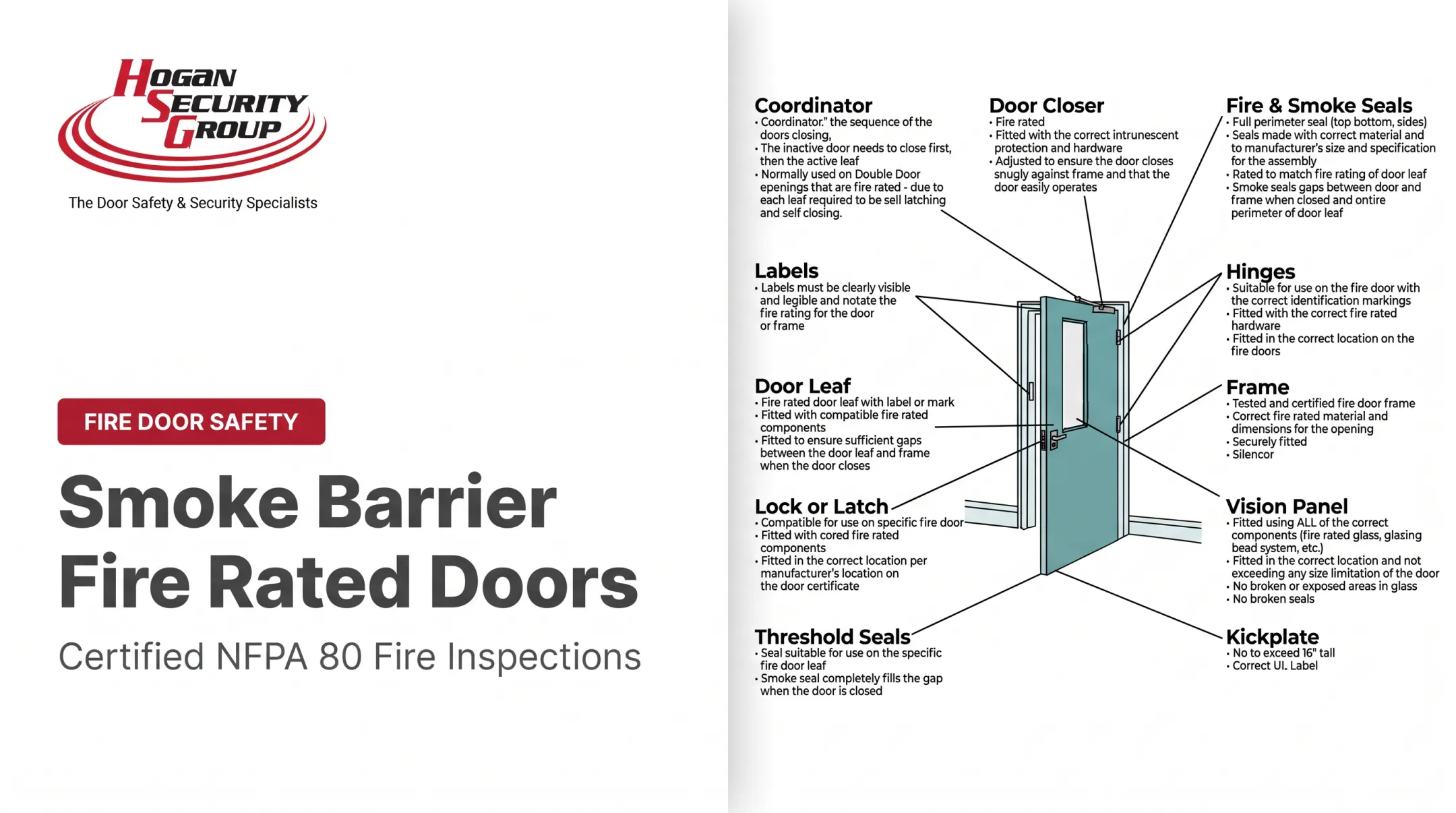
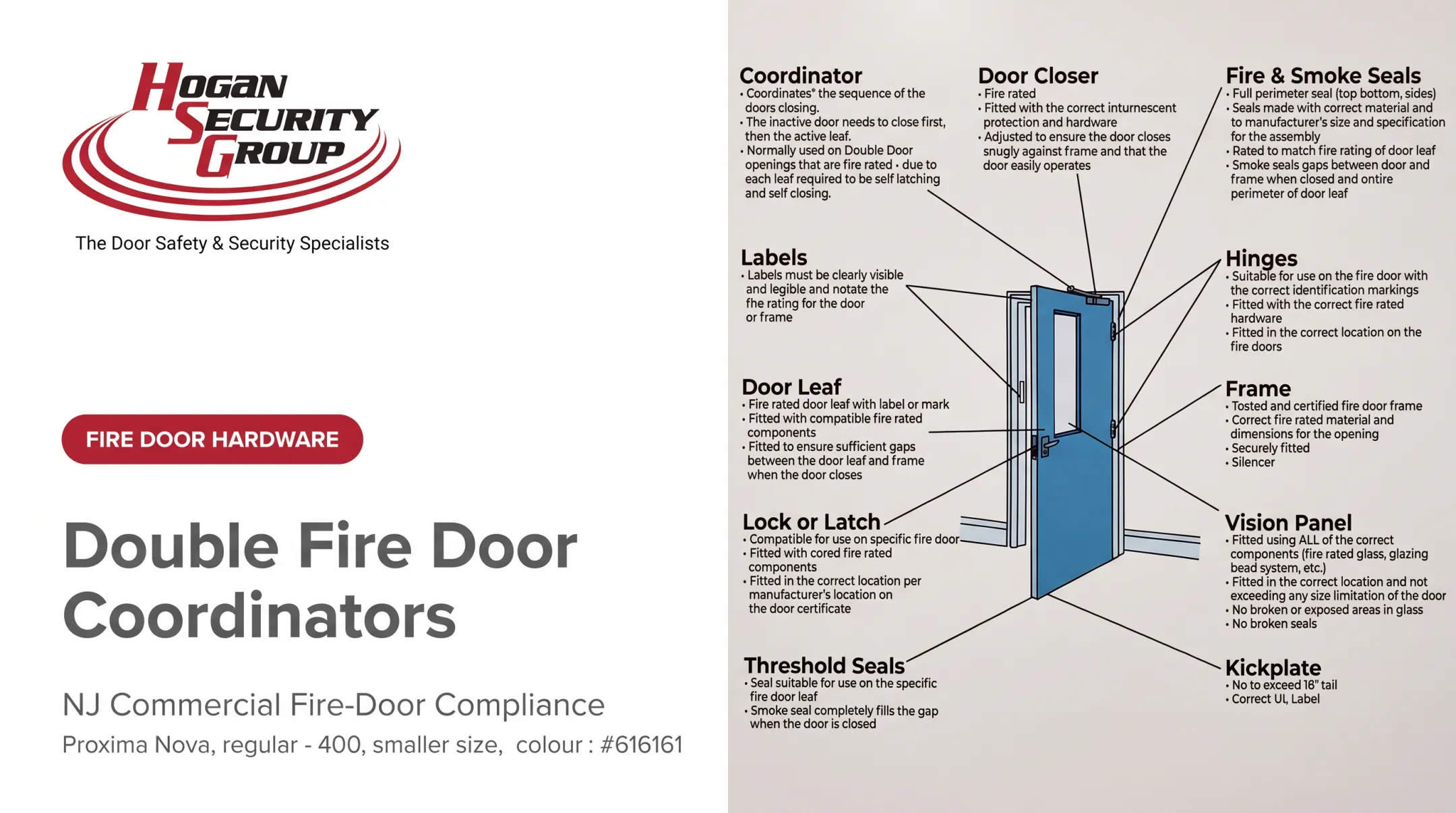
- Every hinge, closer, latch, seal, and fastener must match the listed fire-door assembly
- Verify product labels, manufacturer listings, NFPA80, and your AHJ before replacing hardware
- Call for professional inspection if a door won't close and latch, binds, sags, slams, or has been field-modified
What Are Self-Closing Fire-Rated Door Hinges?
Fire-rated and self-closing get used interchangeably on job sites, but they are not the same thing.
A fire-rated hinge is one that's been tested, labeled, or listed for use in a specific fire-door assembly. Under fire conditions, it has to keep doing its job: supporting the door's weight and keeping it aligned in the frame so the opening stays closed.
A self-closing hinge is a spring-assisted hinge that returns the door to the closed position without a separate overhead closer. "Self-closing" describes how the hinge operates; it says nothing about whether the hinge is rated for fire-door use.
McKinney, a major hinge manufacturer, describes spring hinges simply as hinges with an internal spring mechanism that returns the door toward closed. That is a mechanical function, not a fire listing.
Why Closure and Latching Actually Matter
An open or misaligned door leaf defeats the entire purpose of a fire-rated opening. Compartmentation only works if the door closes completely and the latch engages. A door that swings shut but doesn't latch can pop back open under fire or smoke pressure.
Hinge performance doesn't happen in isolation. It interacts with:
- Door weight and leaf dimensions
- Frame alignment and perimeter clearances
- Latch engagement and type
- Seals (smoke, fire, and threshold)
- Any hold-open or access-control hardware on the opening
Self-closing hinges are also distinct from door closers, automatic operators, and automatic-closing devices. Each has its own code, accessibility, power, and listing considerations. They are not interchangeable solutions for "making a door close."
What Requirements Apply to Hinges on Fire-Rated Doors?
There's no single universal rulebook here. Governing requirements come from the building's adopted codes, the current edition of NFPA80, the fire-door manufacturer's listing, the hinge manufacturer's published instructions, and ultimately your local authority having jurisdiction (AHJ). Always confirm current requirements before finalizing a hardware decision.
Labeling and Listing
Don't assume every fire-door hinge needs an individual UL stamp. According to UL's application guide, conventional leaf-style commercial hinges are specifically excepted from UL's general individual-certification requirement.
Spring hinges marketed for fire-door use (BHMA type K81011F) do need laboratory listing with in-plant follow-up inspection. Check the exact mark and what it covers, rather than rejecting or approving a hinge based on a stamp alone.
Grade Doesn't Equal Fire Listing
ANSI/BHMA A156.1 and A156.17 set mechanical performance benchmarks. Grade 1 hinges, for instance, must survive 2.5 million test cycles. These grades tell you about durability under commercial use, not fire-assembly compatibility.
| Standard | What it tests | Grade 1 benchmark |
|---|---|---|
| ANSI/BHMA A156.1 (Butts and Hinges) | Cycle, wear, friction, strength | 2.5 million cycles |
| ANSI/BHMA A156.17 (Self-Closing Hinges) | Operational cycling, materials | 1 million cycles |

A higher grade may suit a heavy, frequently used commercial door. But grade alone doesn't prove the hinge belongs on a specific listed assembly.
Quantity, Placement, and Selection Factors
Skip the "three hinges per door" shortcut. The correct count and placement come from:
- The door manufacturer's listing
- NFPA80 tables, where applicable
- The hinge manufacturer's written instructions
Other selection factors worth confirming against the listing include:
- Door size, thickness, and weight
- Frequency of use and handing
- Bearing type and frame preparation
A fire rating belongs to the tested assembly, not to a hinge in isolation. A hinge's advertised rating doesn't automatically transfer to every door and frame you install it on.
Spring Hinges vs. Door Closers: Which Self-Closing Option Is Better?
Spring hinges generate closing force through an internal spring. No visible closer arm is needed. For smaller, lighter-traffic openings, that's appealing. Less visual bulk, simpler hardware, fewer moving parts to maintain.
But spring hinges have real limitations. Closing force can be thrown off by:
- Door size and weight
- Frame alignment
- Hinge adjustment and tension
- Air pressure or HVAC drafts
- Latch resistance
- General wear over time
Hager's commercial hinge catalog flags wind, carpet drag, twisted frames, and weatherstripping as conditions that affect spring-hinge performance. It recommends hydraulic closers above certain door-height thresholds. That's a conditional recommendation, not a blanket "closers are always better" statement.
When a Door Closer Makes More Sense
Door closers (surface-mounted, concealed, or floor-mounted) offer controlled closing speed, backcheck, delayed action, and adjustable latching force. For high-traffic institutional openings, like a school corridor door or a hospital stairwell door, that control often beats momentum-based closing. Closers also tend to be easier to adjust without disturbing the hinge or door prep.
Accessibility Considerations
The 2010 ADA Standards set specific thresholds:
- Interior hinged doors (non-fire): 5 lbf maximum opening force
- Fire doors: opening force follows "the minimum allowable by the appropriate administrative authority" (not automatically 5 lbf)
- Spring hinges: door must take at least 1.5 seconds to close from 70 degrees to closed
- Closers: door must take at least 5 seconds to move from 90 degrees to 12 degrees from latch

Schools, healthcare facilities, hospitals, and public buildings need to weigh these force and speed requirements alongside fire-door function. Use spring hinges only when the product, door size, assembly listing, code requirements, accessibility conditions, and AHJ expectations all line up.
How to Select and Install Self-Closing Fire-Rated Hinges
Getting the right hinge is only half the job. Installation quality determines whether it actually performs.
Pre-Purchase Checklist
Before buying anything, confirm:
- The door's current label and fire rating
- Leaf dimensions, thickness, and weight
- Frame type and existing hinge preparation
- Traffic level and latch type
- Accessibility needs for the opening
- Any electrified or access-control hardware already installed
Pull the fire-door manufacturer's listing and the hinge manufacturer's installation instructions, then confirm the hinge, fasteners, quantity, placement, and any intumescent materials are all permitted together on that specific assembly.
Installation Details That Get Overlooked
Hager's spring-hinge installation instructions call out a critical sequence: check whether the door latches properly before adding spring tension. Resistance or latch failure usually means the door is out of balance or misaligned, not under-sprung. Tightening the spring further just masks the real problem.
Hager's Roton catalog adds another common error: skipping center-punching before driving screws lets them "walk," producing cocked screw heads and hinge leaves that won't close flush. Small installation shortcuts like this can throw off an otherwise correct hinge.

Functional Tests for the Finished Opening
Once installed, the door should:
- Swing freely without binding
- Close fully from the required opening position
- Engage the latch every time, not intermittently
- Maintain proper perimeter clearances
- Close without slamming
Troubleshooting Checklist
If a door won't close or latch reliably, check for:
- Sagging or loose hinge screws
- Damaged or worn hinges
- Excessive air pressure or weather-stripping drag
- Latch friction or misalignment
- Frame movement or settling
- Failed closer components
- Unauthorized wedges or hold-open devices
Document every inspection finding, corrective action, product label, and follow-up test. That paper trail is what lets facility teams demonstrate a consistent fire-door maintenance process to an AHJ.
When Should a Professional Inspect or Service the Door?
Some situations call for more than a quick fix. Request a professional evaluation when a rated door:
- Has been altered or modified from its original configuration
- Repeatedly fails to latch
- Shows visible damage to the leaf, frame, or hardware
- Is missing labels
- Has mismatched or non-listed hardware
- Sees high traffic or protects a high-consequence area
NFPA80 requires every fire-rated opening to be inspected and tested at least annually, with a signed written record retained for the AHJ, according to NFPA's 2025 FAQ. That applies even to doors that stay closed and see little use.
K-12 schools, colleges, healthcare facilities, hospitals, corporate campuses, warehouses, and multi-tenant commercial buildings all benefit from coordinated door safety support rather than piecemeal repairs.
Hogan Security Group works across these facility types throughout New Jersey, Pennsylvania, and New York. Its team includes FDAI-certified fire door inspectors and technicians certified with manufacturers including Allegion, Assa Abloy, dormakaba, and Special-Lite.
The company has engineered, supplied, installed, and serviced hardware on more than 65,000 doors, from a single sticky hinge to full assembly replacements.
One caveat: an inspection or repair doesn't guarantee compliance on its own. Final acceptance depends on the adopted code, your AHJ, the listed assembly documentation, and the actual scope of the work performed.
Frequently Asked Questions
Do you need special hinges for fire-rated doors?
Yes. Hinges must be appropriate for the specific listed fire-door assembly. Don't substitute ordinary residential hinges without verifying labeling, manufacturer instructions, and applicable code requirements first.
What are the requirements for hinges on fire-rated doors?
Requirements cover proper labeling or listing, suitable grade and load capacity, approved quantity and placement, compatible fasteners, and correct installation. Always verify against current standards and the specific assembly listing.
What hinge grade is recommended for fire-rated doors?
It depends on door weight, size, traffic, and what the manufacturer's listing specifies. Select the grade and type called out for that particular opening rather than assuming the highest grade is automatically correct.
Where should hinges be placed on a fire-rated door, and how many are required?
Quantity and placement must follow the door and hinge manufacturer's listing along with applicable NFPA80 provisions. Door dimensions, weight, construction, and hardware type can all change the requirement.
Can spring hinges be used on fire-rated doors?
Some labeled spring hinges may be permitted, but suitability depends on the specific assembly listing, door size, closing and latching performance, accessibility requirements, and local code enforcement.
What is a fire-rated hinge?
It's a hinge tested, labeled, or listed for specified fire-door applications that supports the door and helps preserve its operation and alignment during fire exposure. On its own, it doesn't make an entire door assembly fire-rated.