
The gap between paper compliance and field condition is wide. Hogan Security Group's 2025 field data found that 65%+ of fire doors failed their annual inspection, and more than 90% of those failures could be fixed quickly within a standard facility operating budget.
"Fire door requirements 2026" isn't one nationwide rule. Your locally adopted building and fire codes, NFPA standards, product listings and the Authority Having Jurisdiction (AHJ) decide what applies. This guide walks through identifying rated openings, choosing ratings, inspecting, documenting, and fixing problems.
Key Takeaways
- The adopted building code says where rated openings are required; NFPA 80 governs installation and maintenance.
- A fire door is an assembly, not just a labeled slab.
- Required ratings depend on the wall, location, occupancy and local amendments.
- Never wedge or modify a rated door without checking the listing and the AHJ.
What Fire Door Requirements Apply in 2026?
How the Codes and Standards Fit Together
The locally adopted IBC, IFC, NFPA 101 or other code decides whether an opening protective is required and what rating it needs. IBC Section 716 governs opening protectives and directs installation under NFPA 80. In the 2024 IFC, Section 705.2 covers inspection and maintenance.
NFPA 80 (2025 edition) covers installation, hardware, inspection, testing and maintenance. NFPA 105 (2025) addresses smoke-door assemblies.
Why Adopted Editions Matter
A model code edition is not law until a state or municipality adopts it. The 2027 IBC and IFC are available, but adoption varies. Examples effective in 2026:
| State | Adopted code example |
|---|---|
| New Jersey | 2024 IBC effective August 17, 2026; Uniform Fire Code still based on 2018 IFC |
| Pennsylvania | 2021 IBC with modifications, effective January 1, 2026 |
| New York | 2025 NYS Uniform Code, effective December 31, 2025 |
| California | 2025 Title 24, effective January 1, 2026 |
The AHJ reviews plans, inspects, approves alternatives, enforces deficiencies and decides how requirements apply to your facility. Always confirm local amendments with them.
The Life-Safety Purpose
Fire doors serve several life-safety roles:
- Compartmentalize the building
- Slow smoke and flame spread
- Protect exit enclosures and corridors
- Keep egress paths usable
Sprinklers change some provisions, but not the basics. IBC Table 1020.2 reduces certain corridor wall ratings. The 2024 IBC also has a sprinkler exception to the 450°F temperature-rise limit for certain stair and exit-passageway doors.
Neither change waives required ratings, closing, latching or inspection.
What Changed in NFPA 80 (2025)
NFPA's change summary highlights several updates in the 2025 edition:
- Chapter 4 reorganized by door type
- New wood-door glazing requirements
- Deleted field-labeling provisions
- New language on excessive clearances and closer listing
It doesn't establish a new general record-retention interval. Treat the 2025 edition as enforceable only where your jurisdiction has adopted it.
How to Identify a Fire Door Assembly and Select the Correct Rating
Every Part of the Opening Counts
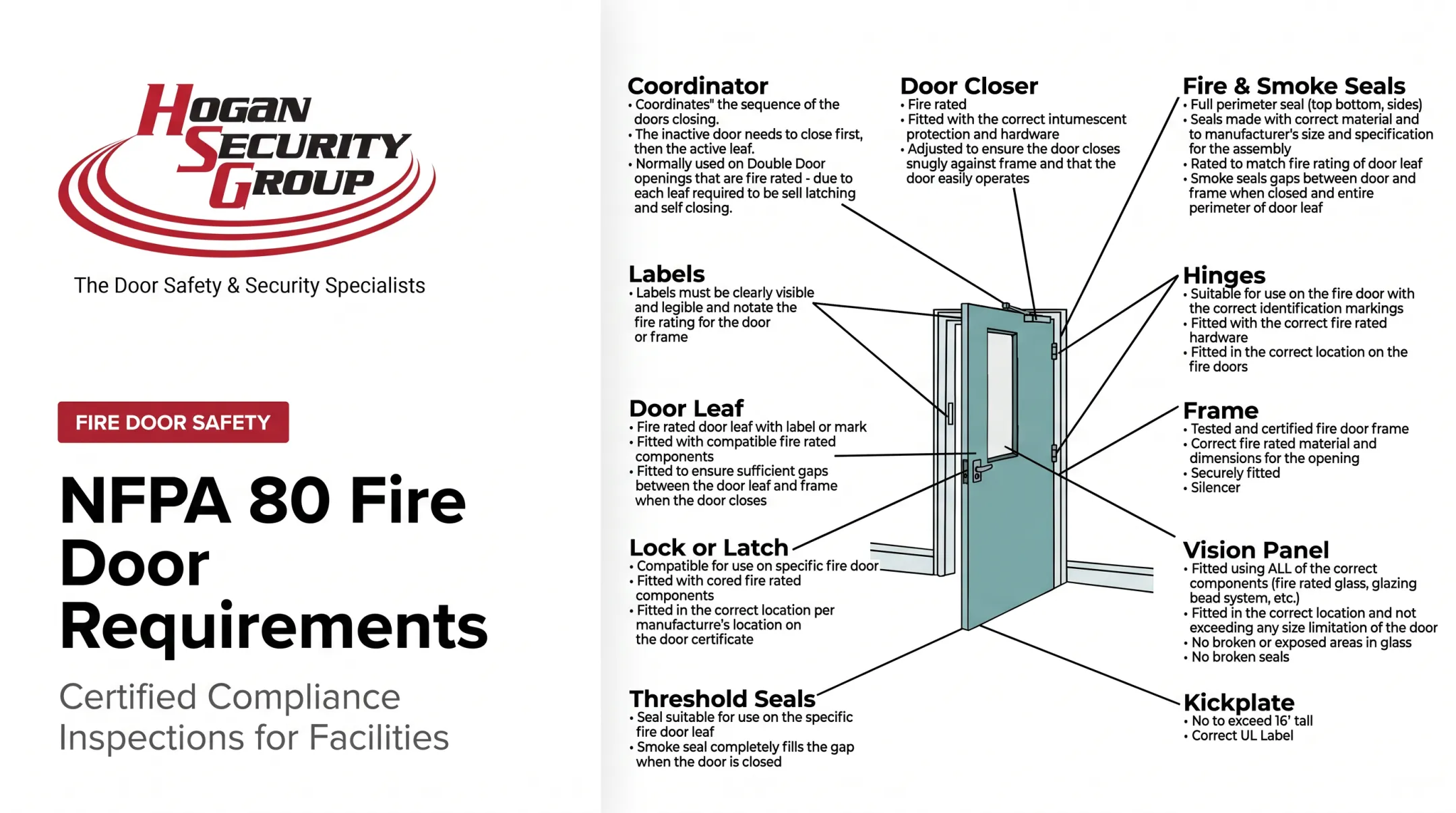
A listed assembly can include:
- Door leaf and frame
- Hinges, closer, latch or exit device
- Glazing and its frame
- Gasketing, edge seals and astragals
- Coordinators on pairs
The assembly is only as good as its lowest-rated component. Unlisted hardware, non-rated glass or an incompatible frame can void the rating even if the door slab has a label.
Reading Labels
Permanent labels appear on the door and frame. For butt hinges, the door label usually sits on the hinge edge between the top and second hinge, and the frame label on the hinge jamb in the same area.
Labels show the certification, the rating (for example 3 HR, 1 HR, 3/4 HR, 30 MIN, 20 MIN) and sometimes a temperature-rise limit. Check the top rail, hinge edge, lock edge and frame.
A missing, painted-over or illegible label is a problem. UL offers field evaluation, so contact the listing agency and AHJ instead of guessing. Painting embossed frame labels is allowed; painting non-embossed ones is not.
Matching the Rating to the Wall
The door rating comes from the wall or barrier it sits in, not its size or look. Examples from 2024 IBC Table 716.1(2):
| Wall | Wall rating | Minimum door rating |
|---|---|---|
| Other fire partition | 1 hour | 45 minutes |
| Other fire partition | 1/2 hour | 20 minutes |
| Exterior wall | 2 hours | 1-1/2 hours |
| Smoke barrier | 1 hour | 20 minutes |

These are illustrations, not substitutes for project-specific review.
FD30 and FD60
FD30 and FD60 are UK-style designations. US specifications use minute ratings and US listings. Don't convert an FD label to a US requirement; confirm the code, listing, wall assembly and AHJ interpretation.
Glazing
Two glazing categories matter for rated openings:
- Fire-protective glazing limits flame and smoke but may pass radiant heat
- Fire-resistive glazing can limit heat when tested and listed
Under the 2024 IBC, fire-protection-rated glazing over 100 sq. in. isn't permitted in the cited door provision, while qualifying fire-resistance-rated glazing can exceed that. Never assume a sprinkler exception permits oversized or unlisted glass.
How to Inspect, Maintain, and Document Fire Doors
Inspection Cycle and Responsibility
Per NFPA's 2025 FAQ, assemblies are inspected and tested after installation and at least annually. A qualified person who understands the door type and components should do it, with credentials acceptable to the AHJ.
Written records must be available for review. The owner or operator stays responsible for inspections and corrections, even when work is delegated.
New Jersey adopted NFPA 80 and expects annual inspection of every rated opening, including doors that sit closed and unused.
Visual Inspection Points
- Legible labels
- Holes, breaks and missing parts
- Glazing and seals
- Hinges, closer, latch and exit hardware
- Coordinators and astragals
- Signs of unauthorized field modification
Also check clearances and alignment. Worn hinges, warped leaves, damaged frames or floor settlement can stop a door from latching. Verify tolerances in the adopted NFPA 80 edition and the listing.
One NFPA Foundation study found that widening a sill gap from 1/4 in. to 3/4 in. increased airflow by 100% to 500% in tested configurations.
Operational Testing
- Open the door and release it. It must close fully against normal resistance.
- Confirm it latches without help.
- Test hold-open devices; they must release on alarm or power loss.
- On pairs, check closing sequence, coordinator, flush bolts, astragal and meeting edges.

Wedging or propping with unlisted devices is prohibited.
Hardware, Egress and Accessibility
Closers, hinges, locks, electric strikes, exit devices and access-control parts must be listed for that fire door configuration. Coordinate fire, egress, accessibility and access control with the manufacturer and AHJ. Fixing one requirement shouldn't create another violation.
Repairs and Modifications
Routine maintenance is allowed. Unapproved drilling, cutting, glazing changes, louvers, hardware swaps and label removal are not. Anything outside the published listing may need manufacturer approval, listing-agency evaluation, field labeling or full replacement. Keep the door closed during repairs.
Where Hogan Security Group Fits
Hogan Security Group has FDAI-certified inspectors who evaluate rated openings, document deficiencies and plan repairs for commercial and public facilities. Its checklist covers more than 20 diagnostics per opening. A professional inspection supports, but doesn't replace, the AHJ's authority or the owner's responsibility.
Common Deficiencies and a Practical Compliance Plan
Frequent Failures
DSSF's inspection list names recurring problems. It gives no failure rate, so treat it as a list, not a statistic.
- Painted or missing labels
- Poor perimeter clearance
- Kick-down holders and blocked-open doors
- Interfering auxiliary hardware
- Missing or defective hardware, incorrect fasteners
- Disabled closers and failed coordinators on pairs
Doors that don't close or latch, and propped doors, need immediate correction. Unlisted glazing or unclear labels need listing confirmation or AHJ review.
A Repeatable Workflow
Capture each opening in an inventory that records location, labels, rating, barrier served, hardware, glazing, inspection date, deficiencies, responsible party and status. Then work this cycle:
- Verify the governing code and amendments
- Inventory the openings
- Inspect and test
- Photograph and document
- Prioritize deficiencies
- Complete listed repairs
- Re-inspect
- Retain records

Portfolio Programs
Schools, healthcare facilities, campuses, plants, warehouses, corporate sites and multi-tenant buildings do better with a program than with reacting to a citation. New Jersey guidance warns that non-compliance fines can reach the tens of thousands of dollars.
Hogan Security Group has inspected 10,000+ fire doors, and a surgery center in 2025 received fire-rated hardware to bring an opening into NFPA 80 compliance. Owners with many openings benefit from one provider coordinating inspection, hardware, locksmith, repair and replacement.
Conclusion: Keep Fire-Rated Openings Ready for Use
Compliance depends on the complete assembly and how it performs today, not on a heavy slab or an old label.
Verify your locally adopted requirements and schedule inspections before problems become urgent. Call a qualified provider such as Hogan Security Group at 609-737-8100 when you need help evaluating, repairing, or maintaining rated openings.
Frequently Asked Questions
Is it compulsory to have fire doors?
Yes, where the adopted building or fire code requires a rated opening protective. That depends on wall type, occupancy, location, adopted code and AHJ.
How do you determine if a door is a fire door?
Look for permanent labels on the door and frame, plus rated glazing and listed hardware. Appearance alone proves nothing.
Do I need FD30 or FD60 fire doors?
Those are UK terms, not usual US ratings. Determine the minute rating from your adopted code, wall assembly, product listing and AHJ.
Do corridor doors need to be fire rated?
Some do, some don't. It depends on corridor construction, occupancy, sprinklers, barrier type and code provisions.
What does a 20 minute fire rated door mean?
It's the fire-protection rating of the listed assembly under its test conditions. It doesn't mean every component or installation automatically qualifies.
How much glass can be in a 20 minute fire rated door?
It depends on the adopted code, the door and glazing listings, and opening location. Check the manufacturer's listing and AHJ before adding or enlarging a vision panel.