
Introduction
A fire door only works when the whole assembly works. The leaf, frame, hinges, closer, latch, seals and glazing all have to be intact. The door has to close and latch every time, and nobody can have modified it without approval.
That's where many facilities fall short. Hogan Security Group's 2025 field data shows 65%+ of fire doors fail their annual inspection. Most of those failures are fixable, but only if someone finds them.
This guide covers the difference between routine maintenance, formal inspections, repairs, documentation and follow-up. Exact requirements depend on the adopted code, the authority having jurisdiction (AHJ), the building type and manufacturer instructions.
Key Takeaways
- Fire-door safety depends on the complete assembly, not the door slab alone.
- Routine staff checks don't replace formal inspections where code requires them.
- Fix defects fast, ban wedging and tying doors open, and avoid field modifications.
- Assign every deficiency, record the repair, and reinspect before closing it.
Fire Door Fundamentals and US Compliance
What makes a fire door an assembly?
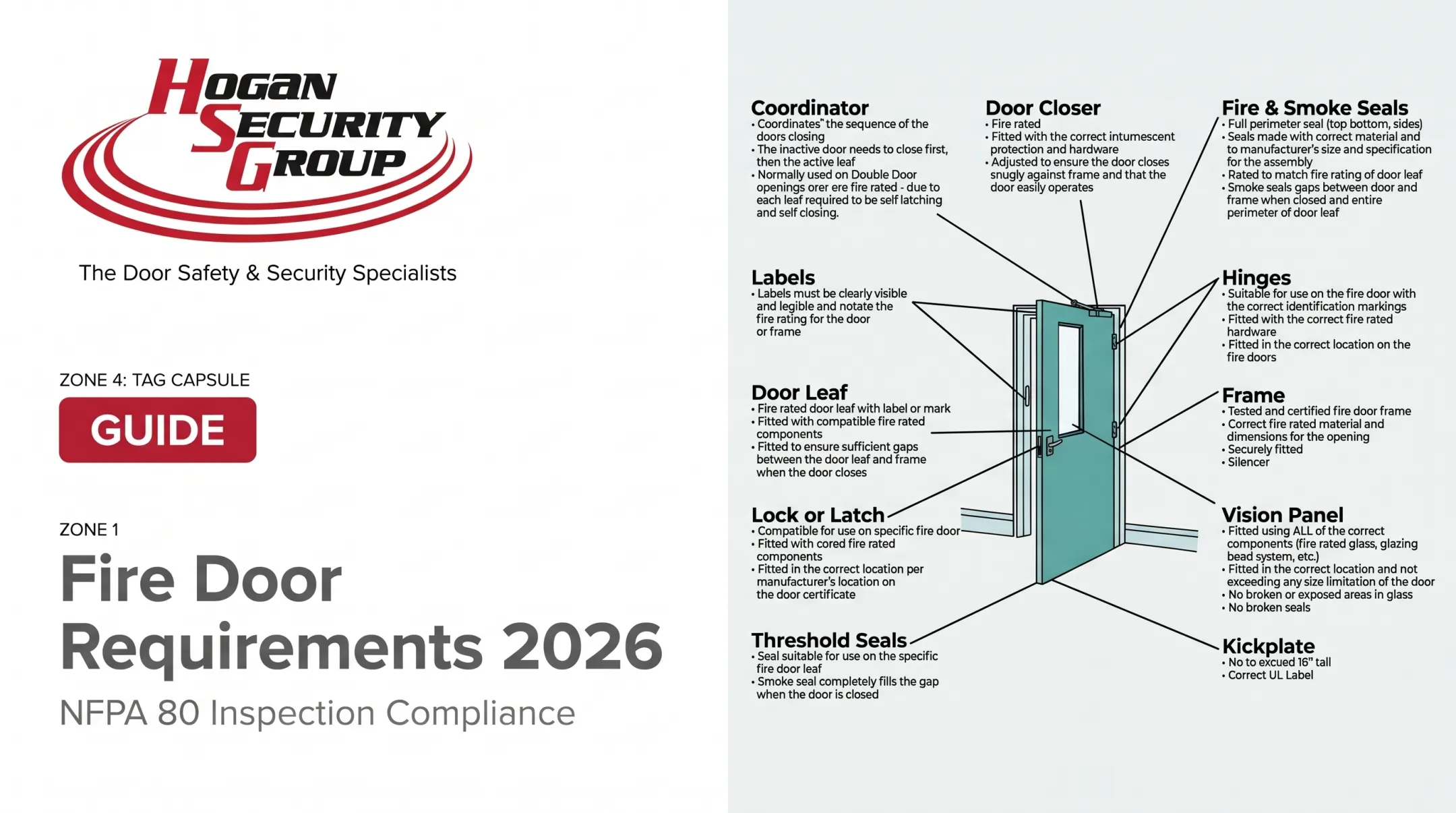
The rating applies to the coordinated door, frame, hardware, glazing, seals and installation. A fire door may arrive as a complete assembly or be built from listed components, but the parts must work together to provide the rated opening protection.
One failed part can defeat the rest. A worn closer lets the door stand ajar, and a missing edge seal lets smoke through a door that looks perfect.
Labels identify the testing and listing. According to NFPA's 2025 FAQ, door, frame and fire-door-window labels show the manufacturer, third-party certification mark, rating and test standard. Hogan's inspectors note that ratings such as 20 or 60 minutes should appear on both door and frame.
US standards and local enforcement
Several documents shape the requirements:
- NFPA 80, the standard for fire doors and other opening protectives
- NFPA 101, the Life Safety Code
- The International Fire Code (IFC), which directs maintenance of opening protectives under NFPA 80 and prohibits blocking fire doors
- Manufacturer listings for the specific assembly
- Your AHJ (authority having jurisdiction), including local amendments
The newest NFPA edition is not automatically the one your jurisdiction enforces. Adoption varies by state:
- New Jersey lists the 2024 IFC under its Building Subcode
- New York's 2025 Uniform Code took effect December 31, 2025
- Pennsylvania made the 2021 IFC effective January 1, 2026
Confirm what your local fire marshal enforces.
Healthcare adds another layer. CMS expects annual fire-door inspection and testing under NFPA 80-2010 for covered facilities.
Responsibility for facility owners and managers
Split duties clearly, or nobody owns them:
- Owners: fund inspections and repairs, and keep records
- Facility managers: schedule work and track deficiencies to closure
- Maintenance staff: make daily observations and report problems
- Tenants: report damage and never prop doors
- Contractors: perform qualified inspections and repairs
In multi-tenant buildings, campuses and hospitals, write down who gives inspectors access. Many corporate sites find that no single person owns fire doors until a fire marshal cites them.
Fire Door Maintenance Requirements
Build a maintenance schedule based on risk and use
NFPA's FAQ says to inspect and test immediately after installation and at least annually afterward. Hogan applies the same baseline to doors that stay closed and unused.
Beyond the annual baseline, set the frequency of extra checks by risk:
- High-traffic stairwells and corridors
- Dormitories and healthcare spaces
- Industrial areas with heavy door abuse
- Humid or corrosive environments
Always confirm any exceptions, such as shorter or longer intervals for certain ratings, against the adopted NFPA 80 text.
Routine visual and operational checks
Staff can safely walk the building and look for:
- Holes, dents, warping or delamination
- Loose or missing fasteners and hardware
- Damaged frames or cracked glazing
- Worn or missing seals
- Blocked swing paths
- Doors that don't close fully or latch
Staff should report, not repair. Adjusting closers, replacing latches and assessing frames call for a qualified technician. These walk-throughs supplement formal inspections and never replace them.
Inspect the complete hardware and sealing system
Check each component against the assembly's listing and manufacturer guidance. Don't assume every door shares the same parts or tolerances.
- Hinges and pivots: secure, aligned, no excessive wear
- Closers and coordinators: door closes from full open, and paired doors close in the right order
- Latches and strikes: positive latching
- Thresholds and gasketing: intact, with intumescent or smoke seals where required
- Vision panels and beads: undamaged, with the right glazing
- Signage and labels: visible and legible
NFPA's swinging-door checklist is based on NFPA 80-2019, so use it as a reference, not a substitute for the adopted edition. Hogan's own checklist runs more than 20 diagnostics per opening.

Prevent practices that defeat fire-door performance
Never wedge, tie, prop, disable or slow a self-closing door. NFPA is blunt: fire doors must stay closed and latched, or close automatically in a fire.
Hold-open devices are acceptable only when listed, correctly installed and permitted by code. The 2024 IBC, for instance, requires automatic closure on smoke detection or loss of power at permitted locations. If staff keep propping a door, the fix is a compliant release device, not a stronger warning sign.
Maintain records throughout the lifecycle
Keep a living file:
- Door inventory with identifiers
- Inspection dates and defects found
- Photographs and work orders
- Parts used and who did the work
- Completion dates and follow-up results
NFPA 80 expects a signed inspection record kept available for the AHJ. In a 2025 CMS survey, one facility was cited for an operating-room fire door that failed to close and latch, along with missing annual inspection records. Surveyors look for functional failures and missing documentation alike.
Fire Door Repair and Deficiency Management
Triage deficiencies by life-safety risk
Sort findings into tiers:
- Urgent: door fails to close, latch, or contain smoke; structural damage; blocked egress. Apply temporary controls such as restricted use or a fire watch per your AHJ, and book service immediately.
- Soon: worn seals, loose hardware, excessive clearances, missing signage.
- Scheduled: cosmetic or administrative issues, such as paperwork gaps.

Hogan's field data shows that 90%+ of failures can be remedied quickly within a standard facility operating budget, so triage rarely means a capital project.
Common repair categories
Typical repairs include:
- Adjusting or replacing closers, latches, hinges and coordinators
- Replacing seals, thresholds and fasteners
- Repairing glazing components
- Repairing or replacing damaged frames
Follow the assembly listing and manufacturer-approved methods for each repair. Hogan's repair service covers damaged or non-compliant doors, including complete assembly replacement and emergency calls.
Protect the assembly's certification and listing
Avoid these field changes:
- Drilling or cutting the leaf or frame
- Adding unapproved locks or stops
- Substituting incompatible hardware
- Altering the closer
- Painting or covering labels
Even a minor change can affect tested performance. UL explains that an inspection reports deficiencies but doesn't certify a modification. A separate field evaluation can assess modified or unlabeled doors, and only a compliant door receives a label.
Decide whether to repair or replace
Weigh the following:
- Extent of damage and altered construction
- Availability of listed parts
- Repeated failures
- Age-related deterioration
- Cost to restore the assembly
No authoritative source sets a universal replacement age, so don't adopt one. Replace when restoring the listed assembly costs more than starting fresh, or when it can't be restored at all.
Verify and close every repair
A finished work order isn't proof of compliance. Test the door after repair:
- It closes from every required position
- It latches correctly
- Seals meet as intended
- Egress isn't obstructed
Then document a reinspection and sign-off.
How to Inspect and Document Fire Doors
Plan the inspection and identify every opening
Start with an inventory. Capture:
- Building and floor
- Opening identifier and assembly type
- Rating, frame details and hardware
- Inspection history and access limits
The 2024 IFC also requires an inventory of fire-resistance-rated construction and an annual visual inspection of it.
Interior doors are the usual candidates, since exterior doors generally aren't fire-rated. In occupied buildings, schedule around patient care, classes, operations and evacuation routes.
Examine labels, leaf, frame, glazing and hardware
Work through each opening in order:
- Labels and markings on door and frame
- Leaf and frame condition, including holes and breaks
- Glazing and beads
- Hinges, fasteners, latches, closers and coordinators
- Thresholds, seals and signage

Use a US checklist tied to your adopted code and the assembly listing. Don't import UK fire-resistance labels or generic clearance values. NFPA 80 §6.3.1.7 sets the clearance criteria.
Test operation rather than relying on appearance
Open, close and latch every door. Check coordinator action and any release or hold-open device. A door that looks fine but fails to close or latch is deficient, and you should record it that way.
Record evidence and assign corrective actions
Each finding needs:
- Door identifier and exact defect
- Priority and photo where useful
- Code or listing reference
- Recommended action
- Responsible party and target date
- Any access or testing limitation
Complete follow-up and portfolio-level review
Reinspect repaired doors and document each closure. Then look across buildings for patterns. If the same closer model keeps failing, replace it everywhere. Trend data supports preventive maintenance and realistic budgets for bigger remediation projects.

When to Use a Qualified Fire Door Professional
Know when in-house checks are not enough
Bring in a qualified professional for:
- Formal annual inspections
- Complex repairs and damaged assemblies
- Missing labels
- Repeated failures
- Fire-rated glazing and frame problems
- Suspected unauthorized modifications
NFPA defines a qualified person as someone with knowledge of the door type and its operating components, subject to AHJ acceptance. No single credential is universally mandated.
Evaluate the inspector or contractor
Ask about:
- Credentials, such as DHI's Certified Fire & Egress Door Assembly Inspector (CFDAI) or Intertek's IQP path
- Experience with your door types
- Manufacturer support and repair methods
- Sample reports and closeout records
- Insurance and any applicable state or local licensing
Credentials don't replace local licensing or AHJ acceptance.
How Hogan Security Group fits
Hogan Security Group is a door safety and security specialist founded in 1982. It provides fire door inspection, repair, and service support for commercial and public facilities in New Jersey, New York, and Pennsylvania. The team includes FDAI-certified inspector Dan Hogan and qualified fire door inspectors Ben Hogan and Ben Kleumpen.
Because Hogan also supplies, installs, and repairs doors and hardware, the same company can correct deficiencies found in a report. When you evaluate inspection providers, ask for:
- An opening-by-opening report with clear deficiencies
- Repair recommendations
- Documented follow-up
An inspection with no path to correction leaves you holding a list of problems.
Frequently Asked Questions
What are the maintenance requirements for fire doors?
Run routine visual and operational checks on the full assembly, follow manufacturer instructions and the adopted code, repair defects promptly and keep records. NFPA 80 calls for inspection and testing at least annually.
What is the typical lifespan of a fire door?
There's no universal lifespan. Condition, traffic, environment, maintenance, damage and whether the listed assembly remains intact decide when replacement is needed.
Should you keep fire doors open at all times?
No. Fire doors must be able to close and latch, and must never be wedged or tied open. Only listed, code-permitted automatic hold-open devices that release on alarm are acceptable.
How often should commercial fire doors be inspected in the US?
NFPA 80 guidance calls for annual inspection, but the adopted code, AHJ, occupancy and risk can change that. Verify local requirements and keep formal inspections separate from routine checks.
Who can inspect and repair a fire door?
Trained staff can make routine observations. Formal inspections and complex repairs belong to qualified professionals with fire-door knowledge, credentials acceptable to the AHJ and familiarity with manufacturer listings.
What should you do if a fire door fails inspection?
Document the failure, prioritize by risk and apply temporary controls if needed. Then have a qualified technician repair it with compatible components, retest it and sign off.