
Facility teams often struggle to tell a quick repair from a full replacement. This guide covers how to make that call, what the repair process looks like, which US codes apply, and how to choose a qualified professional.
Key Takeaways
- A fire exit door and a fire-rated door assembly overlap but aren't identical; confirm function, rating, and occupancy first.
- Repair works when listed, compatible components can restore the whole assembly.
- Evaluate the frame, hinges, closer, latch, seals, glazing, and exit hardware, not just the slab.
- Keep inspection reports, photos, and repair records on file.
When to Repair or Replace a Fire Exit Door
Signs a fire exit door may be repairable
Most problems are fixable. Hogan Security Group's 2025 field data shows that more than 90% of fire-door inspection failures can be remedied quickly within a standard facility-management operating budget.
Typical repair scenarios:
- Loose or worn hinges and hardware
- Minor alignment problems
- Failing closers
- Latch adjustment issues
- Damaged or deteriorated seals
- Limited surface wear
A repair only counts if the assembly stays suitable for its listed application. A qualified technician should confirm the fix won't compromise the fire label, frame, egress function, or manufacturer requirements.
Conditions that may call for replacement
Replacement becomes likely with:
- Serious warping or extensive corrosion
- Burn or impact damage
- Damaged or missing cores
- Large unauthorized cut-outs
- Frame damage that can't be repaired
- Repeated failure to close or latch after proper adjustment
A missing label doesn't automatically mean tearing out the opening. Some existing assemblies qualify for an Intertek field labeling evaluation, assessed case by case. A field label is not approval of a damaged or modified door. Distinguish among full replacement, relabeling, component replacement, and assembly remediation.
How to make the decision
Weigh these factors together:
- Door and frame condition
- Fire rating
- Hardware compatibility
- Occupancy and use
- Repair history (repeat failures point toward replacement)
- Lead time
- The cost of leaving the opening unavailable
No single US-wide threshold defines when core or frame damage is repairable. Don't assume an unlisted patch preserves the rating. Get a case-specific call from a qualified fire-door professional who can verify your jurisdiction's current requirements.

The Fire Exit Door Repair and Replacement Process
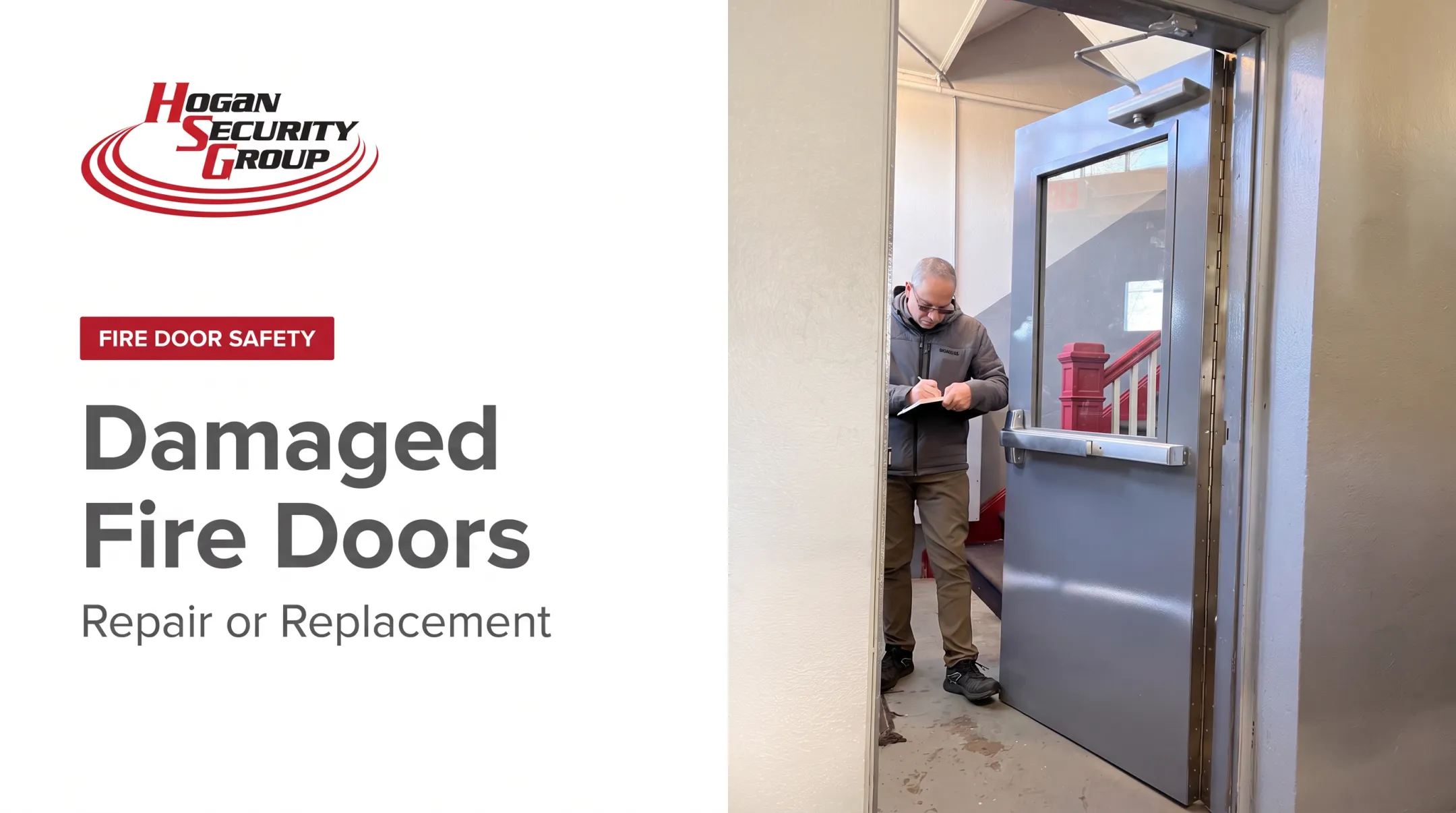
Initial inspection and diagnosis
Document each opening, covering:
- Location and use
- Door and frame labels and rating
- Hardware, glazing, seals, closer, and latch
- Exit device and access-control equipment
- Visible damage and operating defects
Hogan's inspectors work from a checklist of more than 20 diagnostics and issue a report per door.
Take photographs. Write a defect report that separates life-safety issues, security concerns, maintenance items, and conditions needing immediate action.
Scope development and component selection
Replacement parts must be compatible with the listed assembly and the manufacturer's requirements. Don't install generic locks, closers, panic devices, seals, or access-control components without confirming suitability. The 2024 IBC model code prohibits modifying listed hardware and requires fire-door modifications to comply with NFPA 80.
When comparing a repair scope against a replacement scope, price out:
- Door slab and frame
- Hardware
- Installation labor
- Testing and documentation
- Finish
- Lead time
- Any AHJ coordination
Repair or replacement work
Trained personnel should:
- Correct alignment and restore closing and latching
- Install only approved components
- Repair or replace damaged frames
- Preserve required clearances and labels
Never:
- Prop a fire door open
- Disable the closer
- Drill or cut the assembly without approval
- Add a security fix that blocks emergency egress
Testing, handover, and maintenance
Test closing, latching, hinges, seals, glazing, exit hardware, signage, access-control release, and the clear egress path. Exact requirements vary by occupancy and jurisdiction.

The completion package should include:
- Before-and-after photographs
- Inspection findings
- Installed component details
- Warranty information
- Unresolved items
- Maintenance instructions and a schedule for future checks
US Compliance and Safety Requirements for Fire Exit Doors
Applicable codes and authorities
The main references for fire exit doors include:
- NFPA 80 and NFPA 101
- International Building Code (IBC) and International Fire Code (IFC)
- ADA accessibility standards
- State and local fire codes
None of these is automatically binding everywhere. The enforceable edition depends on state and local adoption, occupancy, building age, door rating, and the authority having jurisdiction (AHJ).
NFPA identifies NFPA 80-2025 as its current edition. NFPA's FAQ says to inspect and test after installation and at least annually, by a qualified person, where NFPA 80 applies. New Jersey adopted NFPA 80, which makes annual inspections a legal requirement there.
Egress and exit-door operation
Exit routes must stay unobstructed, and doors must support lawful emergency egress.
As a model-code example, 2024 IBC §1010 requires door swing in the direction of egress for occupant loads of 50 or more, and sets a 15 lbf maximum unlatching force. It also limits delayed egress to listed conditions. Check your adopted text and amendments.
Card access, delayed egress, and classroom lockdown functions must never create a barrier during an emergency. Wisconsin, for example, bars classroom locks that need a key or special knowledge to exit. That is one state's rule, not a national one.
For accessibility, ADA standards generally call for 32 inches of clear width. The 5 lbf opening-force limit doesn't apply to fire doors.
Fire-rated assembly integrity
A rated door works as part of a rated wall and opening system. Integrity depends on:
- Self-closing, positive latching
- Compatible frames and hardware
- Intact labels (door and frame)
- Approved glazing and required seals
- No unapproved holes, wedges, or field alterations
Replacing only the slab may not fix frame, hardware, wall, or installation problems.
Inspection, records, and corrective action
The Steel Door Institute's inspection guide describes signing and retaining inspection records for three years unless otherwise specified, and keeping acceptance-test records for the life of the assembly. Verify the rule in your locally adopted edition.

Maintain a file that shows an organized safety program when the fire marshal visits:
- Opening inventory
- Inspection reports and repair records
- Photos, citations, and completion dates
- Open corrective actions
Common Fire Exit Door Problems That Require Attention
Watch for:
- Doors that won't close or latch
- Damaged closers and loose hinges
- Bent frames
- Missing labels
- Deteriorated seals
- Broken exit devices
- Damaged glazing and corrosion
- Unauthorized field modifications
- Doors routinely wedged open
Common shortcuts make things worse:
- Disconnected closers let smoke and fire pass
- Painted-over hardware stops latches from engaging
- Blocked paths slow evacuation
- Incompatible parts void the listing
- Access-control settings can delay exit
Blocked paths are not a paperwork issue. NIST's investigation of the 2003 Station nightclub fire documented crowding and egress problems at the main entrance, with 100 fatalities. That event was not a rated-door failure, yet it shows what blocked egress costs.
If a required exit is unusable, don't improvise. Get urgent professional guidance, document the interim condition, and coordinate with the building owner, safety lead, and AHJ as needed.
Choosing a Qualified Fire Exit Door Repair Professional
Credentials and technical capability
NFPA 80 calls for a qualified person but doesn't mandate one certification. Look for:
- Documented fire-door inspection experience
- Knowledge of NFPA and locally adopted codes
- Credentials such as DHI's Certified Fire Door Assembly Inspector
- Manufacturer-supported components
- Appropriate licensing
- Ability to assess the whole assembly, not just swap hardware
Ask for written findings, photos, a prioritized repair plan, completion records, warranties, and ongoing maintenance support.
Scope, communication, and value
Compare proposals on more than price:
- Complete scope and assembly compatibility
- Code coordination and documentation
- Emergency response and lead times
- Lifecycle maintenance support
The lowest price rarely covers all of these. Schools, hospitals, campuses, warehouses, and multi-tenant buildings often benefit from one provider handling inspections, repairs, locksmith work, and access control.
Hogan Security Group as a service option
Hogan Security Group, founded in 1982, is a door safety and security specialist for commercial and public facilities. Its team includes FDAI-certified inspectors and holds a New Jersey locksmith license plus Licensed Public Works Contractor status.
Manufacturer relationships include Allegion, Assa Abloy, dormakaba, and Special-Lite. The company has inspected more than 10,000 fire doors and handles inspection, repair, replacement, locksmith, access-control, and life-safety work.
Service hours are Monday to Friday, 8:00 a.m. to 4:30 p.m., with emergency calls carrying a 4-hour minimum call-out fee. Before engaging any provider, verify availability, project scope, credentials, and your jurisdiction's requirements.
Frequently Asked Questions
What is a legal requirement for fire exit doors?
It depends on occupancy, adopted codes, door rating, and the AHJ. Common threads are lawful emergency egress, compatible assembly components, and inspection and maintenance records. No single rule applies everywhere.
What are the new fire door regulations in the UK for 2026?
UK fire-door rules sit in a separate jurisdiction from US requirements. Check current UK government, fire-safety, or qualified professional sources for any 2026 requirements.
How do I know whether a fire exit door needs repair or replacement?
Hardware, alignment, closer, latch, and seal defects are usually correctable. Severe damage, compromised labels, irreparable frames, or an assembly that can't be restored to compliant operation all point toward replacement.
What should be checked during a fire door inspection?
Door, frame, labels, hinges, closer, latch, seals, glazing, exit hardware, access-control release, signage, and clearances. Above all, confirm the door closes and latches fully.
Can a fire-rated door be modified or fitted with new hardware?
Only if changes are compatible with the listed assembly and applicable requirements. Use qualified professionals instead of drilling, cutting, or installing unapproved components.
How often should fire exit doors be inspected and maintained?
The schedule depends on the adopted code, occupancy, jurisdiction, and manufacturer guidance. NFPA 80 calls for at least annual inspection where it applies. Confirm local requirements and record every inspection and correction.